
Communication Skills Classes for Kids in Guwahati
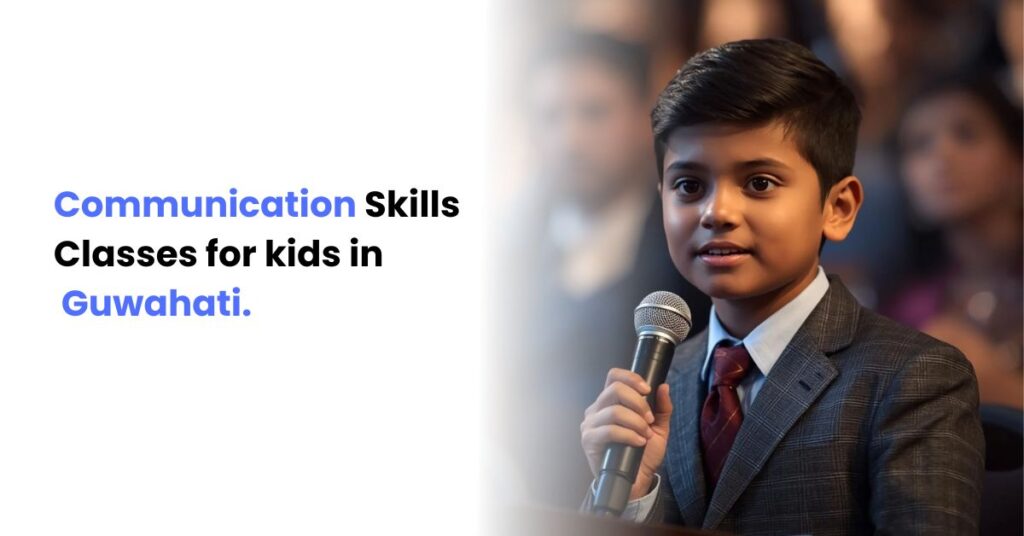
Ask any teacher in Guwahati what separates an average student from an exceptional one — and nine out of ten will not say marks. They will say confidence. The ability to express ideas clearly. The courage to ask questions and the skill to answer them. In one word: communication.
And yet, despite its obvious importance, communication is the one skill that almost no school in Assam actively teaches. Children are graded on what they know, never on how effectively they can share what they know with the world.
That gap is exactly what Voice out Loud Academy’s communication skills classes in Guwahati are designed to close — systematically, joyfully, and in a way that sticks for life.
What Are Communication Skills? (A Parent-Level Explainer)
When most parents hear “communication skills,” they think of two things: speaking fluently in English, and being able to give a good speech. Both are useful. But neither is what communication skills actually means — and understanding this distinction is the first step to knowing what your child truly needs.
Communication skills are the complete toolkit a person uses to exchange ideas, emotions, intentions, and information with another person — clearly, confidently, and appropriately. This toolkit has many layers:
- Verbal communication — the words you choose and how you organise them
- Non-verbal communication — facial expressions, posture, eye contact, hand gestures
- Listening — genuinely processing what someone else is saying, not just waiting for your turn
- Tone and voice modulation — knowing when to be assertive, when to be warm, when to be formal
- Questioning and clarification — the ability to ask the right questions to deepen understanding
- Persuasion and influence — the art of changing minds without force
- Empathy in conversation — reading an emotional situation and responding appropriately
A child who has all seven of these skills does not just perform well on stage. They do better in classroom discussions, group projects, job interviews, college admissions, and every relationship they will ever form. Communication skills for children in Guwahati are not an extracurricular add-on. They are a life skill foundation.
Why Spoken English ≠ Communication Skills
This is perhaps the most important thing this article will tell you — and it is something many parents in Guwahati discover only after spending years on spoken English classes with disappointing results.
Spoken English is a language skill. Communication is a human skill.
A child can speak grammatically perfect English and still be a terrible communicator. They can stumble over pronunciations and still hold a room spellbound. Language is the vehicle. Communication is the driver.
Here is what spoken English classes typically teach:
- Correct grammar and sentence construction
- English pronunciation and accent softening
- Vocabulary expansion
- Basic conversation drills
Here is what they typically do not teach:
- How to read a room and adjust your message
- How to maintain eye contact without it feeling aggressive
- How to handle disagreement without shutting down
- How to listen actively instead of passively
- How to structure a persuasive argument on the spot
- How to use silence as a communication tool
- How to manage nervousness so it does not hijack performance
A child who completes a spoken English course may sound more polished. But a child who completes a structured communication skills programme in Guwahati becomes genuinely more capable — in every area of life that involves another human being.
This is not a criticism of English language training, which has its own value. It is simply clarity about what parents are actually looking for when their child struggles to express themselves — and what kind of training actually addresses it.
The 7 Communication Skills Voice Out Loud Teaches
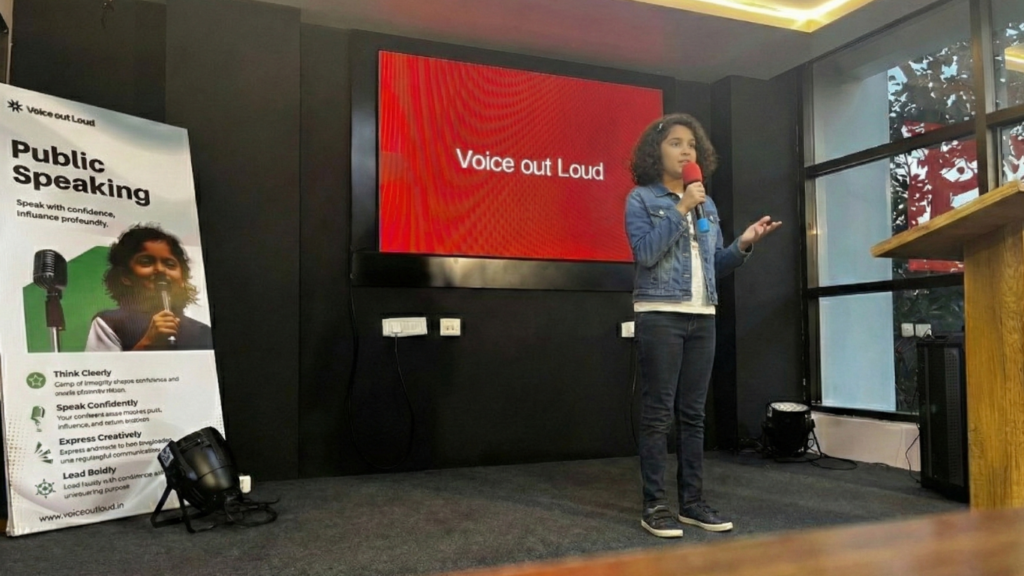
At Voice out Loud Academy, our communication curriculum is built around seven core competencies. Every batch, every activity, every performance challenge is designed to develop one or more of these skills in an age-appropriate, engaging way.
Skill 1: Confident Self-Expression
This is the foundation. Before a child can communicate with anyone else, they need to be comfortable communicating as themselves — with their own voice, opinions, and personality. We train children to express their genuine thoughts without over-apologising, shrinking, or performing a version of themselves they think others want to see.
Skill 2: Structured Speaking
Good communication is organised. We teach children how to open a conversation or speech with impact, develop a clear middle, and land a memorable close — the same three-act structure used by TED speakers, great teachers, and effective leaders worldwide. Children as young as seven can master a simple version of this.
Skill 3: Active Listening
The most underrated communication skill, and the one most classes skip entirely. We run structured listening exercises where children practise paraphrasing, summarising, and responding to what they actually heard — not what they assumed. This transforms both their conversational ability and their academic performance, since most classroom learning is delivered through listening.
Skill 4: Body Language and Presence
Research suggests that over 55% of communication happens through non-verbal signals. We train children in intentional posture, confident eye contact, open gestures, and controlled facial expression — so their body says the same thing their words are saying.
Skill 5: Tone and Voice Modulation
The same sentence delivered in different tones sends completely different messages. We teach children to consciously use pace, pitch, volume, and pause to control how their communication lands — a skill that makes them dramatically more effective in presentations, conversations, and conflict situations.
Skill 6: Persuasion and Argumentation
Every child will need to make a case for something — to a parent, a teacher, a peer group, a future employer. We teach structured persuasion using age-appropriate debate formats, group discussions, and negotiation exercises. Children learn to build an argument with evidence, acknowledge counterpoints, and land a conclusion that actually changes minds.
Skill 7: Empathetic Communication
This is the skill that determines the quality of every relationship a child will ever have. We teach children to recognise emotional cues in others, adjust their communication style based on the listener, and navigate disagreement without cruelty or collapse. In a world increasingly concerned with emotional intelligence, this is the skill that separates truly effective communicators from merely articulate ones.
Age-Wise Breakdown: What Your Child Learns at Each Stage
Communication skills training is not one-size-fits-all. A five-year-old and a fifteen-year-old need fundamentally different approaches. Here is how Voice Out Loud structures the journey across three age groups:
Ages 5–9: Foundations of Expression
At this stage, the goal is not polish — it is freedom. Children in this group often have tremendous things to say but lack the confidence and vocabulary structure to say them. Our classes for this age group use storytelling, puppetry, role play, show-and-tell formats, and playful performance games to build expressive courage.
Key outcomes for this age group:
- Comfortable speaking in front of a group without anxiety
- Basic storytelling structure (beginning, middle, end)
- Voice projection and clear articulation
- Simple listening and responding skills
- Positive association with being seen and heard
Ages 10–14: Building the Communicator’s Toolkit
This is the most important developmental window for communication skill-building. Children at this age have the cognitive capacity for structured learning but are simultaneously battling self-consciousness, peer pressure, and the beginning of a strong inner critic. Our programme for this group balances skill training with confidence rebuilding.
Key outcomes for this age group:
- Structured public speaking (2–5 minute speeches)
- Group discussion and debate participation
- Active listening and response techniques
- Body language awareness and control
- Persuasive writing and speaking
- Handling stage nervousness with specific techniques
Ages 15–18: The Advanced Communicator
Teenagers in this group are preparing for board exams, college interviews, competitive events, and eventually, the professional world. Our advanced programme focuses on high-stakes communication scenarios — interviews, group discussions, competitive debates, leadership communication, and personal branding.
Key outcomes for this age group:
- Extempore and impromptu speaking
- JAM (Just a Minute) and GD (Group Discussion) mastery
- Interview preparation and personal narrative building
- Advanced persuasion and influence techniques
- Executive presence fundamentals
- Managing conflict and disagreement in communication
VOL vs. Tuition Centres: An Honest Comparison
Many parents in Guwahati consider enrolling their child in tuition centres that offer “personality development” or “spoken English” as an add-on. Here is a clear, honest comparison to help you make the right decision:
| Feature | Voice out Loud Academy | Typical Tuition Centre |
|---|---|---|
| Primary Focus | Communication & performance skills | Academic subject coaching |
| Communication Training | Dedicated, structured curriculum | Ad-hoc or add-on module |
| Trained Faculty | Specialists in public speaking & child development | Subject matter teachers |
| Methodology | Experiential — learn by doing, performing, presenting | Instructional — taught at desk |
| Batch Size | Small (8–12 children) for individual attention | Large (20–40 students) |
| Stage Exposure | Regular internal and public performances | Rare or none |
| Body Language Training | Structured, dedicated module | Not covered |
| Soft Skills Coverage | All 7 skills, age-appropriately | Usually limited to vocabulary/grammar |
| Progress Tracking | Monthly performance reports for parents | Marks-based assessment only |
| Parent Involvement | Regular updates, demo sessions, open days | Minimal |
| Outcome | Holistic confident communicator | Improved English or subject score |
The right choice depends on what you want for your child. If the goal is marks, tuition centres deliver. If the goal is a child who can walk into any room in the world and communicate with confidence — that is what Voice out Loud is built for.
What Guwahati’s Parents Are Saying
“We tried spoken English classes for two years. His grammar improved but he was still terrified of raising his hand in class. few months at VOL and his class teacher called me to ask what had changed — he is now the one leading discussions.” — Parent of a 12-year-old student, Bhangagarh
“The age-wise structure is what convinced me. They don’t treat a six-year-old and a sixteen-year-old the same way. The curriculum is genuinely designed in age specific manner” — Parent of two children (ages 7 and 14), Narengi
Frequently Asked Questions
Q1. Are these classes conducted in English or Assamese?
A. Our classes are conducted primarily in English, as building confidence in English-medium communication is one of our core goals. However, our trainers are fluent in Assamese and use it freely to explain concepts, support younger children, and ensure no child feels left out because of language barriers. The goal is confident communication — not linguistic perfection from Day One.
Q2. How many classes per week and what is the duration?
A. Our standard programme runs two sessions per week, each 60–75 minutes long. This frequency is intentional — enough to build consistent momentum without overwhelming a child’s existing school schedule.
Q3. My child is already good at English. Do they still need this?
A. Almost certainly yes. English fluency and communication effectiveness are different skills. Many of our highest-performing students academically are children who can write brilliantly but freeze in group discussions or interviews. Communication training works on the skills that English classes do not cover — presence, persuasion, listening, body language, and the ability to think and speak simultaneously under pressure.
Q4. Is there a demo class available?
A. Yes. We offer a free demo class for all new students. This gives your child a no-pressure experience of the VOL classroom before any commitment is made. It also gives our trainers a chance to understand your child’s current level and recommend the most suitable batch.
Q5. Do you offer online communication classes for kids in Assam?
A. Yes. We offer online sessions for families across Assam who are outside Guwahati or prefer the flexibility of remote learning. The curriculum is identical; the format is adapted for online engagement. Contact us to discuss online batch schedules.
Q6. How do I know if my child is making progress?
A. We provide monthly progress notes to parents, tracking each child across the seven communication skills. In addition, children perform at internal showcases every 6–8 weeks, which gives parents a direct, visible demonstration of their child’s growth.
Book a Consultation or Enrol Today
Your child has ideas worth sharing. Stories worth telling. Questions worth asking. Opinions worth defending. The only thing standing between them and the confident communicator they can become is the right training environment.
Voice out Loud Academy’s communication skills classes in Guwahati give children that environment — structured, expert-led, warm, and genuinely effective across all age groups from 5 to 18.
📲 Enrol/Book a consultation— WhatsApp Us Now
Click the button below to message us on WhatsApp:
Contact us-👉Connect on WhatsApp
Call Us at : 6001588904
Or visit us at: voiceoutloud.in 📍 Voice out Loud Academy, Bhangagarh, Rajgarh Road, Guwahati, Assam
Batches filling fast. Limited seats per age group.
Also Read: Stage Fear Classes for Children in Guwahati