
Confidence Building Classes for Kids in Guwahati
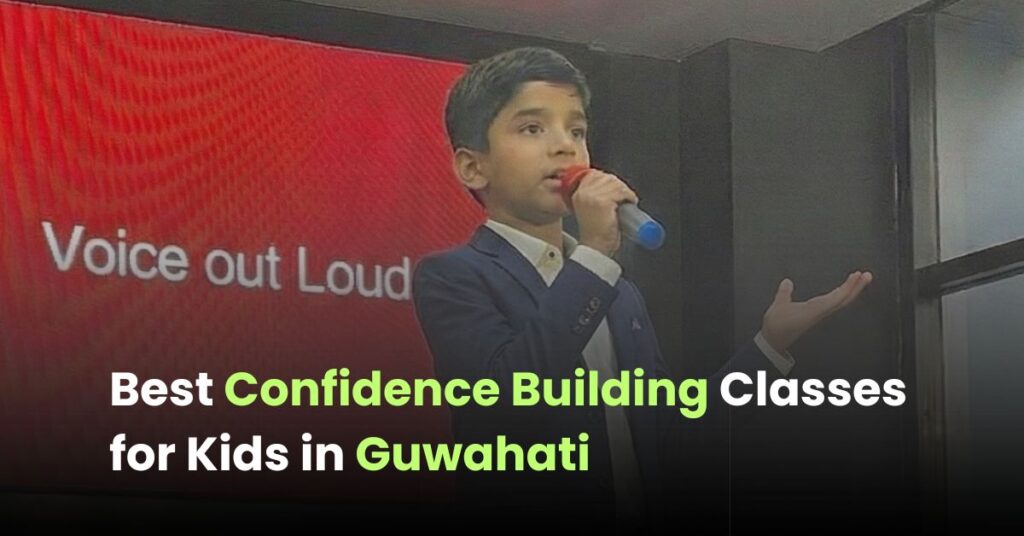
Some children walk into a room and own it. Others stand at the doorway, waiting to be told it is okay to come in.
If your child is the second kind — the one who goes quiet in unfamiliar company, who whispers instead of speaks, who says “I can’t do it” before even trying — this page is written for you.
At Voice out Loud, we run confidence building classes in Guwahati designed specifically for children who are hesitant, shy, introverted, or simply untrained in the art of showing up for themselves. And in our experience, most of these children are not lacking confidence. They are lacking practice.
That is a much more solvable problem.
Is Your Child Shy — Or Just Untrained?
This is the question most parents never think to ask. And it changes everything.
There is a common belief that shyness is a personality trait — fixed, inherited, permanent. “She’s just like that.” “He takes after his father.” “Some kids are quiet by nature.” These statements are not wrong, exactly. But they stop parents from asking the more useful question: even if my child is naturally quiet, have they ever been taught how to be confident?
Think about it this way. A child who has never had a swimming lesson might be terrified of the pool. A parent who says “she’s just not a water person” may be right — or they may simply have a child who has never been shown that the water is safe, that floating is learnable, and that with practice, the fear becomes excitement.
Confidence works the same way.
Introversion is a personality trait — and a perfectly valid one. Many of the world’s most extraordinary leaders, artists, and thinkers are introverted. But confidence is a skill. It is built through repeated safe exposure, through small wins that stack into a new self-image, through a trained environment that shows a child: your voice matters, and using it is safe.
Here is the key distinction:
A shy child is one who feels social discomfort in new situations — this is temperament, and it deserves to be respected, not forced away.
An untrained child is one who has never been given the tools, language, and practice to express themselves effectively — this is a gap that structured classes directly fill.
Most children who come to us are both. And our job is not to change who they are. It is to give them the skills to show the world who they already are — on their own terms, at their own pace.
Our confidence classes for shy children in Guwahati are built around exactly this philosophy: respect the child’s nature, build the skill, watch them surprise themselves.
5 Signs Your Child Needs Confidence Building Training
Parents often wait too long because the signs are easy to dismiss as “just a phase.” Here is what to watch for:
1. They avoid situations where they might be noticed
New classroom, new relative, school function — they retreat. Not because they are rude or uninterested, but because being seen feels unsafe.
2. They say “I don’t know” when they do know
In class, at home, in conversations — your child opts out rather than risk being wrong in front of others. This is not laziness. It is self-protection.
3. They apologise before they speak
“Sorry, I just wanted to say…” — this pattern in children signals a deep belief that their voice is an imposition on others. It is one of the clearest early signs of low confidence.
4. They let others speak for them
Siblings, parents, friends — someone else always ends up answering for them. Over time, this becomes a habit that removes the child further from their own voice.
5. They give up quickly when challenged
Not because they are not capable, but because confidence and persistence are deeply linked. A child who does not believe in their own ability stops trying sooner — in academics, friendships, and every area of life.
If you recognise three or more of these in your child, confidence building classes in Guwahati at Voice out Loud are worth exploring.
The Confidence-Communication Link: The VOL Method
Most confidence-building programmes in Guwahati focus on mindset — they tell children to “believe in themselves” and send them home with affirmations. This feels good in the moment. It rarely produces lasting change.
At Voice out Loud, we take a different approach rooted in one core insight:
Confidence is not something you feel before you act. It is something you build by acting.
This means we do not wait for a child to feel confident before we ask them to speak. We create a carefully designed environment where speaking — imperfectly, nervously, quietly — is welcomed, celebrated, and repeated. And through that repetition, the confidence follows.
The mechanism behind this is what we call the Confidence-Communication Loop:
Speak → Get a positive response → Feel slightly safer → Speak again → Feel slightly more capable → Speak in a bigger situation → Confidence grows
Every class at Voice out Loud is designed to move each child one step forward in this loop — not by rushing them, but by making the next step feel just barely possible. That edge — the place just beyond comfort but not yet in panic — is where all real growth happens.
This is why communication training and confidence building are not two separate things at our academy. They are the same thing. You cannot teach a child to speak with presence without building their confidence. And you cannot build genuine confidence without giving them real, visible communication skills.
Our self confidence classes for kids in Assam give children both — simultaneously, through practice, performance, and positive reinforcement in every single session.
What Actually Happens Inside a VOL Class

Parents often ask: “What will my child actually do in class?” Here is an honest picture.
Your child attends two classes every week. Not once a week — twice. That frequency is intentional. Confidence is built through repetition, and two sessions a week means the momentum never dies between classes. The child does not forget the safety of the room. They do not have time to retreat back into avoidance. The practice stays warm.
And here is the part that surprises most parents: your child gets on stage from the very first week.
Not after three months of preparation. Not after they “feel ready.” From Week 1. Because waiting until a child feels confident before asking them to perform is exactly backwards — the performance is what creates the confidence, not the other way around.
That first stage moment is deliberately gentle. It might be saying their name and one thing they love. It might be finishing a sentence starter. It is short, it is safe, and it is celebrated. But it happens. And the moment a child walks off that stage and hears applause — even for fifteen seconds of a nervous introduction — something shifts.
The Classes Are Built on Fun, Not Fear
Every session at Voice out Loud is designed around one rule: learning happens best when a child is not aware they are being trained.
There are no textbooks. No worksheets. No homework sent home on Friday night. Zero burden. The skills — voice projection, eye contact, structured thinking, confident body language — are embedded inside activities the children genuinely enjoy. Children leave class energised, not drained.
The trainer’s job is to make every child feel that what just happened was fun — while quietly knowing that what just happened was also deeply formative.
Beyond the Classroom: Real Crowds, Real Stages
Voice out Loud’s Voice of Tomorrow event — held recently in Guwahati — is one example of what this looks like in practice. Children who joined the academy as children who could barely introduce themselves stood on a real stage, in front of a real audience, and performed. Not because they were the most talented. Because they had been prepared — week by week, class by class — until the stage felt like a natural place to be.
These events are not reserved for the top performers. Every child participates. Because real confidence — the kind that follows a child into classrooms, interviews, and life — is only built when the crowd is real.
What Confidence Looks Like After a Few Months
The transformation is not dramatic and sudden. It is quiet and cumulative — and then one day, visible and unmistakable.
A child who arrived whispering is now projecting to the back of the room. A child who used to look at their shoes is now making eye contact with an audience of fifty. A child who said “I can’t” in Week 1 is delivering a two-minute speech in Week 10 — and asking when the next event is.
That is not performance coaching. That is confidence, slowly and permanently ingrained — through practice, through stages, through fun, and through being seen and heard twice every single week.
At Voice out Loud we Forge Future Leaders

A Glimpse from a recent public speaking event at Voice out Loud
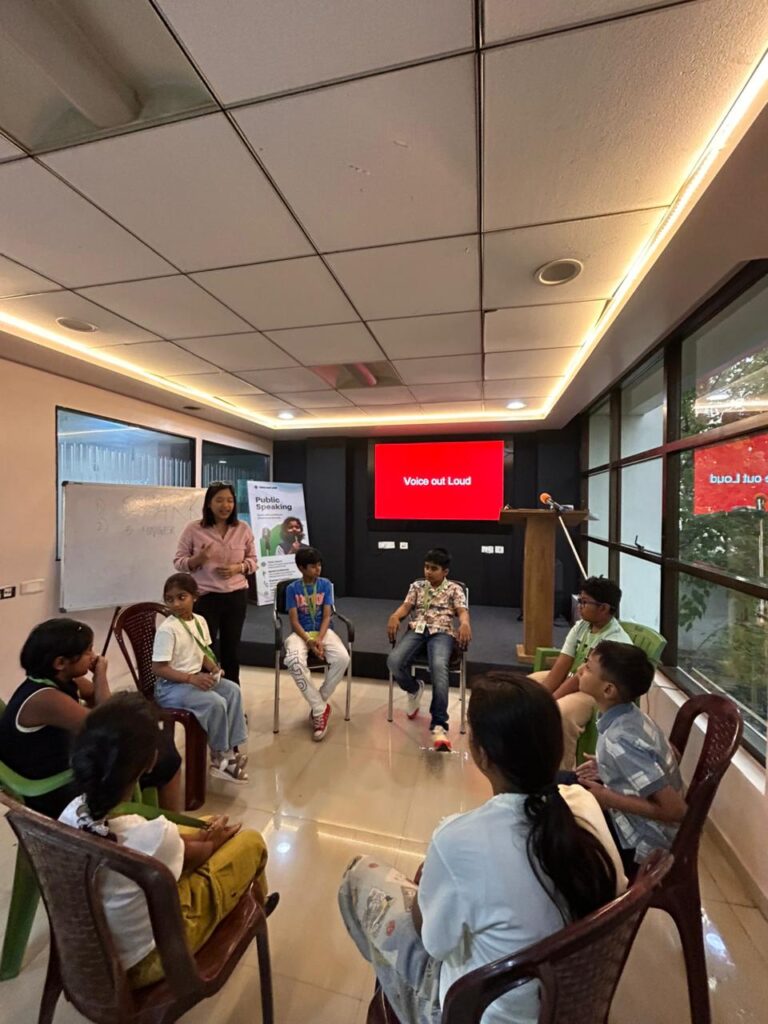
Voice out Loud Bhangagarh Centre Classroom
Confidence Building at Every Age: How VOL Adapts
Confidence Through Play
Confidence is built entirely through joyful, low-stakes participation. Children this age learn confidence through storytelling games, puppet play, group movement activities, and guided sharing circles. There is no formal “performance” pressure. The goal is simply: every child speaks, every child is heard, every child feels good about it.
Confidence Through Competence
Children begin to compare themselves to peers — and this is when confidence can take a significant hit if not supported. Our programme for this group focuses on building visible, tangible communication skills that a child can see growing in themselves. When a child knows they can tell a compelling story, make a strong argument, and hold eye contact with an audience — that knowledge becomes confidence that no comparison can take away.
Confidence Through Challenge
Teenagers need to be challenged, not coddled. Our senior programme creates real pressure scenarios — mock interviews, competitive debates, extempore challenges, audience Q&A sessions — and teaches students to perform under that pressure. The confidence that emerges from successfully handling a hard situation is qualitatively different from anything affirmations can produce. It is earned, and it is permanent.
Frequently Asked Questions About Confidence Building Classes in Guwahati
What are confidence building classes for children in Guwahati?
Confidence building classes for children in Guwahati are structured training programmes that help shy, introverted, or hesitant children develop the ability to speak up, express themselves, and present themselves with ease in front of others. At Voice Out Loud Academy in Guwahati, these classes combine public speaking practice, communication skill training, breathing techniques, and regular performance opportunities to help children build lasting self-confidence in a safe, judgment-free environment.
How do I make my shy child more confident in Guwahati?
The most effective way to build confidence in a shy child is through structured, repeated, low-stakes speaking practice in a supportive group environment. Rather than forcing a shy child into uncomfortable situations at home or school, enrol them in a dedicated confidence building class in Guwahati where a trained coach gradually increases the challenge level as the child’s comfort grows. Voice Out Loud Academy specialises in working with shy and introverted children in Guwahati, using a step-by-step method that respects the child’s nature while systematically expanding their comfort zone.
At what age should a child start confidence building classes?
Children can begin confidence building classes as early as age 5. The earlier a child starts, the easier it is to build a strong confident baseline before peer comparison and academic pressure set in. However, Voice Out Loud Academy in Guwahati offers programmes for children up to age 18 — and significant transformation is possible at every age. There is no age that is too late to begin.
Are confidence classes suitable for introverted children?
Yes — introverted children are often the ones who benefit the most from structured confidence training. Introversion is a personality trait, not a problem. Our confidence classes for introverted children in Guwahati are specifically designed to respect a quieter nature while giving introverted kids the practical tools to speak up when they choose to. We never try to turn an introverted child into an extrovert. We simply give them skills so that their introversion is a choice, not a limitation.
How long does it take to see results from confidence building classes?
Most parents notice a visible change in their child within 4–6 weeks of joining Voice Out Loud’s confidence building programme in Guwahati. Early signs include willingness to participate in class, making eye contact with unfamiliar adults, and speaking up at home with more ease. Deeper transformation — where a child actively seeks out performance and speaking opportunities — typically happens within 3–5 months of consistent attendance.
Does Voice Out Loud offer confidence classes for shy children specifically?
Yes. Voice Out Loud Academy’s confidence classes in Guwahati are particularly well-suited for shy children. Our trainers are experienced in working with children who are hesitant, anxious about speaking, or deeply self-conscious. We use a gradual exposure method, small batch sizes of 8–12 children, and a judgment-free classroom culture to ensure that shy children feel safe enough to take their first steps toward confident self-expression.
The Right Class. The Right Time. The Right Child.
Your child does not need to be a natural performer. They do not need to want to be on stage. They do not need to be naturally outgoing, loud, or charismatic.
They just need one thing: a space where it is safe to try.
That is what Voice Out Loud Academy offers. A structured, warm, expert-guided environment where shy children become speakers, quiet children become leaders, and untrained children discover what they were always capable of.
Confidence building classes in Guwahati for kids — batch seats are limited.
📲 Book Your Child’s Free Demo Class Today
📞 Call: 6001588904 📍 Voice out Loud Academy, Bhangagarh, Rajgarh Road, Guwahati, Assam 🌐 voiceoutloud.in
Batches for all age groups — 5 to 18 years. Limited seats per batch.
Also Read: