
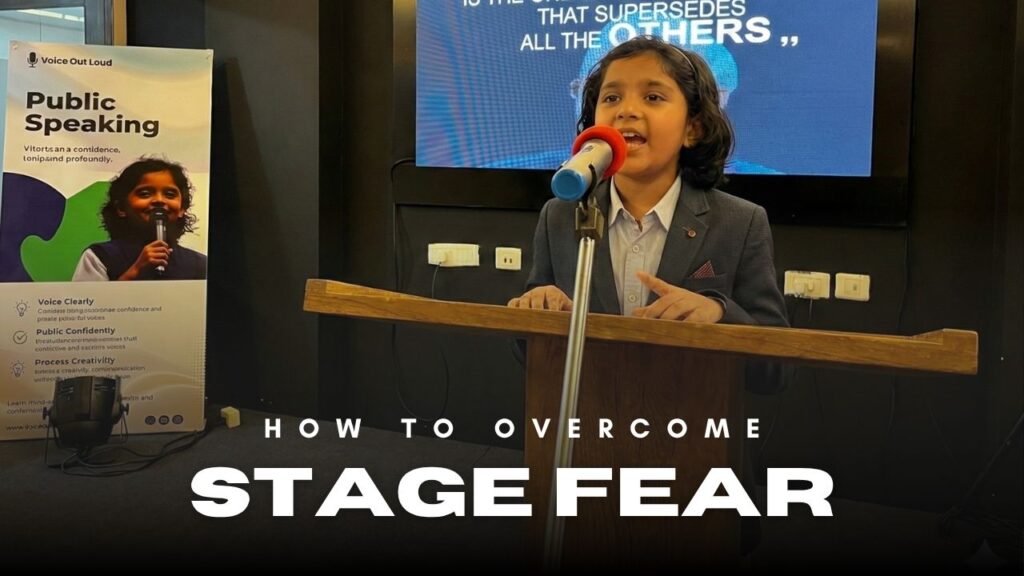
| By Voice Out Loud Academy | Guwahati’s First Dedicated Public Speaking School for Children |
It was Annual Day. Priya had rehearsed her lines for three weeks. She knew every word. At home, she delivered her poem with such confidence that her grandmother clapped at the end every single time.
But when she walked on stage and looked out at the sea of faces — parents, teachers, hundreds of eyes — her mind went completely blank. She froze. She whispered a few words, then walked off, her cheeks burning.
If you are a parent in Guwahati reading this, there is a good chance that scene feels familiar. Stage fear in children is one of the most common — and most misunderstood — challenges parents face. And it is also one of the most solvable.
This guide will explain exactly what stage fear is, why it happens, and give you 7 practical techniques to help your child overcome it.
What is Stage Fear — And Why Does it Happen?
Stage fear (also called stage fright or glossophobia) is the anxiety a person feels when they have to speak or perform in front of others. It is not a character flaw. It is not shyness. It is not a sign that your child is weak.
It is biology.
When your child stands in front of a crowd, their brain detects a threat — even if the threat is not real. The amygdala (the brain’s alarm system) fires, triggering a flood of adrenaline. Heart rate goes up. Palms sweat. The throat tightens. The mind goes blank.
This is the same fight-or-flight response that helped our ancestors escape predators. Today, the brain cannot tell the difference between a tiger and an audience of 200 parents holding phones. The physical reaction is the same.
The good news: because this is a learned fear response, it can be unlearned. And with the right approach, children learn not just to manage stage fear, but to use that energy as fuel.
How Common is Stage Fear in Children?
Research consistently shows that fear of public speaking is among the most common fears worldwide — in many studies, it ranks higher than the fear of death. Among Indian school children, teachers regularly identify stage fear as one of the top barriers to participation in class.
In Guwahati, we see this pattern clearly at Voice Out Loud Academy. When new students join us, approximately 7 out of 10 are dealing with some form of stage fear — ranging from mild nervousness to complete freezing. Within a few months of structured practice, the transformation is remarkable.
The key word is structured. Ad-hoc encouragement at home rarely solves stage fear. What works is a gradual, systematic approach — which is exactly what we will walk you through below.
7 Proven Techniques to Help Your Child Overcome Stage Fear
1. Never Force — Invite Instead
The most common mistake parents make is pushing their child onto a stage before they are ready. This can deepen the fear and create a negative memory that the brain holds onto for years.
Instead of: “Go on, you have to do it,” try: “Would you like to try saying just the first line? That’s all.”
Tiny wins build confidence. One line today becomes a whole verse next month. Give your child agency over their exposure, and the fear loses its grip.
2. Separate the Person from the Performance
Children often link performance with identity. A bad speech becomes “I am bad.” Help your child understand that a speech is something they do, not something they are.
After every speaking attempt — good or bad — focus your feedback on the effort, not the outcome: “I noticed you kept going even when you felt nervous. That took real courage.”
This builds what psychologists call a growth mindset — the understanding that skills improve with practice, not talent.
3. Use the Power of a Safe Audience
Stage fear is fundamentally about the audience. So the solution is to start with an audience that feels completely safe.
- Start with speaking in front of a mirror
- Graduate to speaking to one parent, then both parents
- Then a sibling or a trusted friend
- Then a small group of 4-5 familiar faces
- Then a slightly larger, less familiar group
Each step desensitises the brain. By the time your child stands in front of a class or an auditorium, their brain has evidence that audiences are survivable.
4. Teach Breathing as a Tool — Not a Cliché
“Take a deep breath” is advice parents give, but most children do not know how to do it correctly under pressure. The right technique is diaphragmatic breathing:
- Breathe in slowly through the nose for 4 counts
- Hold for 2 counts
- Breathe out slowly through the mouth for 6 counts
Practise this with your child before bed — not just before a performance. When the breathing pattern becomes a habit, the body can access it automatically when stress hits. At Voice Out Loud, we teach this as part of every warm-up session.
5. Reframe the Physical Sensations
Here is something most parents do not know: the physical sensations of excitement and anxiety are almost identical. Fast heartbeat, butterflies in the stomach, heightened alertness — these happen in both states.
Train your child to say: “I am excited” instead of “I am nervous.” Research by Harvard professor Alison Wood Brooks found that this simple reframe significantly improves performance under pressure.
Teach your child: “Your body is getting ready to do something big. Those butterflies are your energy, not your enemy.”
6. Over-Prepare the Opening Line
The most frightening moment in any speech is the first sentence. Everything after that gets easier. So over-prepare it.
Your child should be able to say their opening line in their sleep, in the middle of dinner, while watching cricket — anywhere, anytime. When the opening is automatic, the brain has one less thing to panic about when the moment arrives.
At our academy, we call this the “launch line” — and we practise it until it is completely effortless. It is one of the fastest confidence builders we know.
7. Create Regular, Low-Stakes Speaking Opportunities
Stage fear grows in silence. The more a child avoids speaking, the more power the fear accumulates. The antidote is regular, frequent, low-pressure speaking practice — not just before Annual Day.
- Ask your child to order food at a restaurant
- Have them call a relative and lead the conversation for 2 minutes
- Ask them to present what they learned at school during dinner
- Let them introduce themselves to new adults in the family
These small, everyday moments build the speaking muscle. Public speaking is not a performance skill — it is a communication skill, and it grows with use.
When Home Practice Is Not Enough
These seven techniques are powerful — and consistent home practice will make a real difference. But there is a ceiling to what self-guided practice can achieve.
The reason is simple: stage fear is rooted in the audience. Practising alone or with family does not fully replicate the experience of speaking in front of peers, a class, or an unfamiliar group. At some point, children need a safe environment where they practise in front of real audiences — regularly, with expert feedback.
This is exactly what a structured public speaking programme provides.
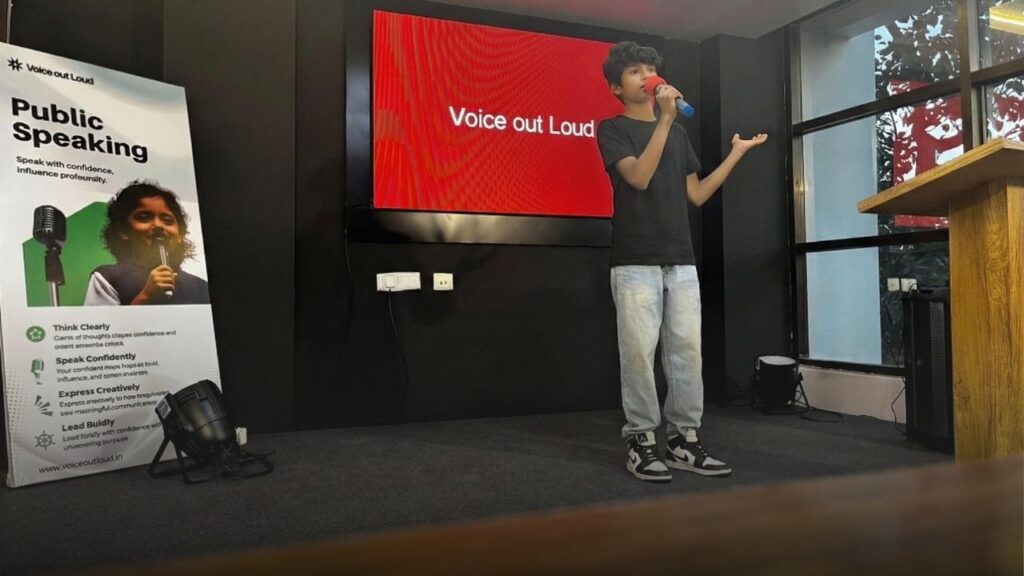
| At Voice Out Loud Academy in Guwahati, children practise speaking in front of their peers in small, supportive groups from their very first session. Our trained mentors help each child identify the specific root of their stage fear — whether it is fear of forgetting, fear of judgement, or physical anxiety — and give them the precise tools to overcome it. |
A Note to Parents: Your Reaction Matters More Than You Think
Children watch their parents closely. When a child hesitates before a speech and sees anxiety on a parent’s face, the brain registers: “This must be dangerous.”
When a child stumbles through a speech and the first thing they hear is criticism, the lesson learned is: “Speaking publicly leads to pain.”
Your calm confidence — your belief that your child can do this — is one of the most powerful tools available to you. Celebrate the attempt, not the perfection. “You walked on that stage. I am proud of you” will do more for your child’s courage than a coaching session.
Stage Fear Is Not Permanent
Some of history’s most powerful communicators were once terrified of speaking. Mahatma Gandhi reportedly struggled intensely with public speaking in his early years. Warren Buffett described his early fear of public speaking as debilitating — and credits taking a public speaking course as one of the most important things he ever did.
Stage fear is not a life sentence. It is a skill gap — and skill gaps close with the right practice.
The children who come to Voice Out Loud Academy frozen with fear are, within months, the ones taking the microphone voluntarily. Not because they became different people. Because they built a skill, one small step at a time.
Ready to Help Your Child Find Their Voice?
If your child is struggling with stage fear, the best thing you can do is give them a safe, structured environment to practise. At Voice Out Loud, Guwahati’s first dedicated public speaking academy for children, we do exactly that — for children aged 5 to 18, in small, supportive batches.
| Book a FREE demo session at Voice Out Loud Academy. Call us at +91 6001588904 or visit voiceoutloud.in/enroll-book-a-demo/ — Let your child take their first step from silence to self-expression. |
Frequently Asked Questions
At what age does stage fear start in children?
Stage fear can begin as early as age 5-6, when children become aware of social evaluation. It often intensifies around ages 9-12 as children become more self-conscious. However, it can be addressed effectively at any age.
Can introverted children overcome stage fear?
Absolutely — and introverted children often become exceptional speakers. Introversion is not the same as stage fear. Many introverted children are deeply thoughtful and articulate; they simply need a structured, low-pressure environment to build confidence.
How long does it take to overcome stage fear?
With consistent, structured practice, most children show noticeable improvement within 6-8 weeks. Significant transformation — from avoidance to confident participation — typically happens over 3-6 months.
What is Voice Out Loud Academy?
Voice Out Loud is Guwahati’s first dedicated public speaking academy for children and teenagers (ages 5-18), located at Bhangagarh, Guwahati. We offer structured programmes in public speaking, storytelling, debate, and leadership communication, with small batches and expert mentors.