
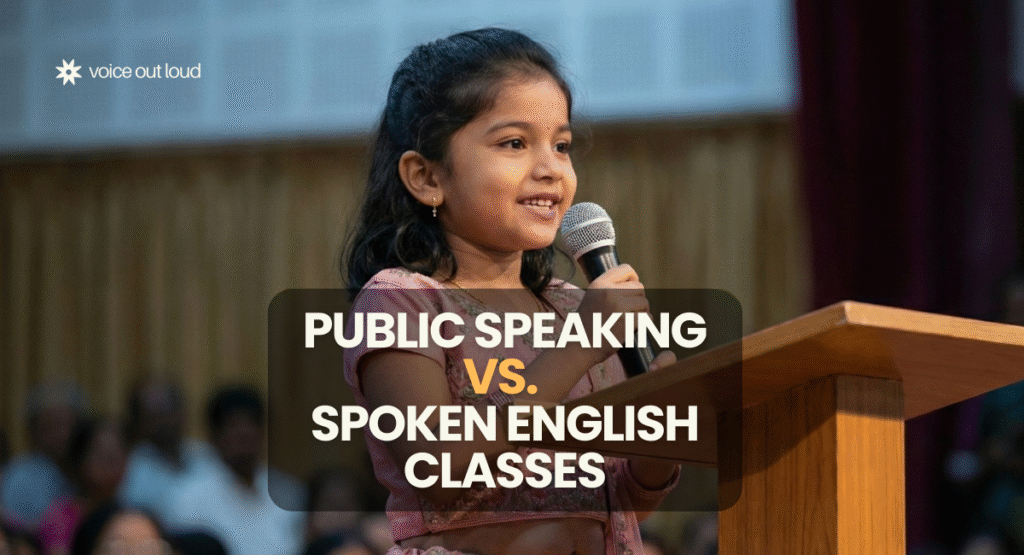
If you are a parent in Guwahati, you have likely faced this dilemma. You watch your child struggle to express themselves—perhaps they are shy in front of relatives, quiet in the classroom, or nervous about school presentations. Your first instinct might be to search for “Spoken English classes in Guwahati.”
It is a common assumption: If my child learns better English, they will become more confident.
But often, this is a misconception. Many children in top Guwahati schools already have excellent grammar and vocabulary. They can write perfect essays. Yet, when asked to stand up and speak, they freeze.
The problem isn’t their English; it’s their Public Speaking skills.
At Voice Out Loud, Guwahati’s first dedicated public speaking academy for kids and teens, we meet hundreds of parents who are confused about the difference. They enroll their children in tuition centers expecting a personality transformation, only to find their child is still shy—just with better grammar.
In this comprehensive guide, we will break down the crucial differences between Spoken English and Public Speaking in Guwahati, helping you decide exactly what your child needs to thrive in the real world.
The “Speaking Paradox”: Why English Medium Isn’t Enough
Guwahati is the educational hub of Northeast India. We have incredible schools and a generation of children who are growing up with English as their first academic language.
However, fluency does not equal impact.
- Spoken English is about correctness: Grammar, vocabulary, and sentence structure.1
- Public Speaking is about effectiveness: Confidence, body language, voice modulation, and persuasion.2
We see many students who score 90% in English exams but cannot look an interviewer in the eye. This is because schools and traditional tuitions focus on what to say (content), but they rarely teach how to say it (delivery).
If you are looking for public speaking courses in Guwahati, it is vital to understand that you are looking for a skill set that goes far beyond language. You are looking for leadership.
Deep Dive: What is Spoken English Training?
To make the right choice, let’s first define what a typical Spoken English class involves. In Guwahati, these classes are often extensions of tuition centers.
The Focus: The Mechanics of Language
Spoken English classes primarily fix the “technical” errors in speech.
- Grammar: Correcting tenses (Past vs. Present).
- Vocabulary: Learning new words to replace simple ones.
- Fluency: Reducing fumbling when constructing sentences.
- Accent Neutralization: Reducing Mother Tongue Influence (MTI).
Who Needs This?
If your child struggles to form sentences, mixes up genders or tenses, or has a very limited vocabulary that prevents them from being understood, then a foundational Spoken English course is helpful.
However, if your child speaks English fluently at home but goes silent in public, more grammar classes will not solve the problem.
Deep Dive: What is Public Speaking Training?
Public speaking in Guwahati is a rapidly growing field because parents are realizing that technical skills aren’t enough for modern success. Public speaking is the art of influencing an audience—whether that audience is one person (an interviewer) or one hundred people (a hall).3
The Focus: The Art of Connection
At Voice Out Loud, our curriculum targets the psychological and physical aspects of communication.
- Confidence & Mindset: Overcoming the fear of judgment (Glossophobia).
- Body Language: Using hand gestures, posture, and eye contact to command respect.
- Voice Modulation: varying pitch, pace, and volume so they don’t sound robotic or monotone.4
- Content Structure: How to organize thoughts logically (Introduction -> Body -> Conclusion).
- Critical Thinking: How to think on their feet during debates or extempore.
Who Needs This?
Does your child fit this profile?
- They speak English well with friends/family but freeze in front of strangers.
- They speak too fast or mumble when nervous.
- They avoid eye contact.
- They have good ideas but can’t convince others.
- They want to be leaders (Head Boy/Girl, Captains) but lack the “presence.”
If this sounds familiar, your child doesn’t need grammar drills. They need public speaking classes.
Detailed Comparison: Curriculum and Outcomes
Let’s compare these two approaches side-by-side to see why public speaking courses offer a more holistic transformation for your child.
| Feature | Spoken English Classes | Public Speaking Classes (Voice Out Loud) |
| Primary Goal | Language correctness (Grammar) | Confidence and Impact (Leadership) |
| Methodology | Textbooks, worksheets, reading aloud | Stage practice, microphones, role-play |
| Classroom Vibe | Academic, seated at desks | Active, standing, moving, performing |
| Skill Learned | How to construct a sentence | How to persuade and inspire an audience |
| Feedback Focus | “You used the wrong verb.” | “You need more eye contact and energy.” |
| Outcome | Better grades in English exams | Better performance in life (Interviews, Debates) |
As you can see, while Spoken English is a component of communication, Public Speaking is the application of it.
Why “Voice Out Loud” Focuses on Public Speaking in Guwahati
When we established Voice Out Loud, we made a conscious decision. We didn’t want to be just another tuition center in Zoo Road or Ganeshguri. We wanted to be an academy that builds future leaders.
We realized that Guwahati has hundreds of places to learn English, but very few safe spaces where a child can learn to overcome fear.
1. The “Activity-Based” Difference
You cannot learn to swim by reading a book about water. Similarly, you cannot learn public speaking by sitting at a desk.
Our classes are dynamic. We use:
- Storytelling Workshops: To unlock creativity.
- Mock TV News Reports: To teach clarity and pacing.
- Debates: To teach logic and respectful disagreement.5
- Improv Games: To teach quick thinking.
This is why we are ranked as the top destination for public speaking in Guwahati. We turn learning into “serious fun.”
2. Small Cohort Advantage
Unlike crowded tuition centers where 30 kids sit in a room, we maintain small cohorts.
Public speaking is a vulnerable activity. It takes courage to stand up. In a small, supportive group, shy children feel safe enough to take that first step. Our mentors, led by founders Bhawana and Digori, know every student’s name, their specific fears, and their unique strengths.
ALSO READ:
Top 5 Benefits of Public Speaking Classes in Guwahati for Kids & Teens: Ultimate Guide
5 Signs Your Child Needs Public Speaking Classes Immediately
Still unsure? Here are 5 red flags that indicate your child needs communication training, not just language tuition.
1. The “Answer-Hiding” Syndrome
You know your child studied hard. You quizzed them at home, and they knew every answer. But at the parent-teacher meeting, the teacher says, “He is very quiet. He never raises his hand.”
This is a confidence issue, not a knowledge issue. Public speaking training helps bridge the gap between what they know and what they show.
2. Monotone or Mumbling Speech
Does your child speak in a flat, robotic voice? Or do they speak so softly that people constantly say, “Can you repeat that?”
Voice modulation is a key pillar of our curriculum. We teach children how to throw their voice to the back of the room without shouting, and how to use pauses for effect.
3. Screen Addiction and Social Awkwardness
In the age of smartphones, children in Guwahati are forgetting how to read social cues. If your child struggles to greet guests, avoids eye contact, or cannot hold a conversation without looking at a phone, they need the social skills training that comes with public speaking.
4. Fear of the Spotlight
If the mere mention of a school elocution competition or an annual day performance makes your child anxious or teary-eyed, they are suffering from Glossophobia. The only cure is gradual, guided exposure in a safe environment—which is exactly what we provide.
5. Lack of Leadership “Presence”
Maybe your child is ambitious. They want to be a Class Captain or eventually crack the APSC/UPSC exams. Leaders are defined by their ability to influence others. Public speaking is the primary tool of influence.
The Long-Term ROI: Why This Matters for Guwahati Parents
As parents, we are always looking for the best Return on Investment (ROI) for our children’s education.
Why is investing in public speaking courses in Guwahati worth it?
Future-Proofing for Careers
The job market is changing. Automation and AI are taking over technical tasks.6 What AI cannot do is empathize, negotiate, and inspire.
- Corporate Sector: Companies expanding in the Northeast need managers who can pitch to clients.
- Entrepreneurship: If your child wants to start a business, they must be able to sell their vision.
- Civil Services: The interview round of APSC/UPSC is purely a test of personality and communication.
By starting at age 8, 10, or 12, you are giving your child a massive head start. They will enter college and the workforce with a skill that most adults are still trying to learn.
Academic Excellence
It is a myth that public speaking distracts from studies. In fact, it enhances them.
- Critical Thinking: Debates teach students how to structure arguments, which improves essay writing in History and English.7
- Memory: Memorizing speeches and key points improves retention skills needed for exams.8
Frequently Asked Questions (FAQs)
Q: My child’s English grammar is weak. Should they join Voice Out Loud?
A: Yes! While we are not a grammar tuition center, public speaking is the best way to improve language naturally. When children want to express an idea, they are motivated to find the right words. We provide corrective feedback on grammar in a supportive way during their speeches.
Q: Do you offer online classes?
A: While we believe offline interaction is best for overcoming stage fear, we do offer specific modules. However, for parents in Guwahati, we strongly recommend our offline center to get the full benefit of stage practice and peer interaction.
Q: How long does it take to see results?
A: Confidence is a journey. However, most parents notice a difference in their child’s posture and willingness to speak within the first few months of our structured program.
Q: Is this helpful for introverts?
A: Absolutely. We don’t try to turn introverts into extroverts. We teach introverts how to use their natural thoughtfulness to become powerful, calm speakers. Some of the world’s best speakers (like Barack Obama) are natural introverts who learned the skill.
Conclusion: Choose Confidence, Not Just Correctness
The distinction is clear.
If you want your child to pass a grammar test, a Spoken English tuition is fine.
But if you want your child to lead a team, ace an interview, win a debate, and walk through life with their head held high, they need Public Speaking training.
Guwahati is growing, and the opportunities for our children are endless—but only if they have the voice to seize them.
At Voice Out Loud, we are committed to helping every child in Guwahati find that voice. We are not just teaching them to speak; we are teaching them to shine.
Does your child need that extra edge?
Don’t wait for the fear to set in. Join the academy that is defining Public Speaking in Guwahati.
[Book Your Free Demo Session Today]
Visit us at [Location below] or call us to learn more about our upcoming batches.